

Can Kidney Stones Be Treated Without Surgery? A Urologist Explains Your Options
One of the first questions patients ask after being diagnosed with a kidney stone is:
“Doctor, will I need surgery?”
The good news is that not every kidney stone requires surgery. Many kidney stones can be treated successfully with medication, hydration, and regular medical supervision. However, the right treatment depends on several factors including the size of the stone, its location, the symptoms it causes, and its effect on kidney function.
At Dhameliya Kidney Hospital & Lithotripsy Centre, Surat, we regularly treat patients with kidney stones using both non-surgical and advanced minimally invasive techniques. Understanding your options can help you make informed decisions and avoid unnecessary anxiety.
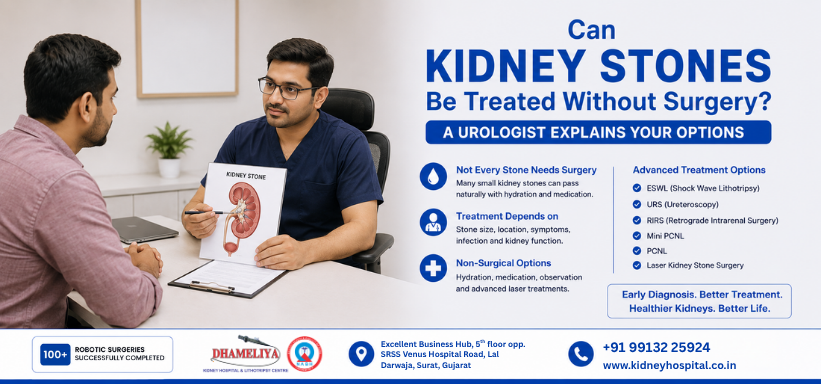
Image generated using OpenAI AI tools.
What Is a Kidney Stone?
A kidney stone is a hard deposit made of minerals and salts that forms inside the kidney. These stones develop when urine becomes concentrated, allowing minerals to crystallize and stick together.
Common types of kidney stones include:
- Calcium Oxalate Stones
- Uric Acid Stones
- Struvite Stones
- Cystine Stones
Kidney stones can vary greatly in size. Some are as small as a grain of sand, while others can grow large enough to block urine flow and damage kidney function.
Why Do Kidney Stones Form?
Several factors can increase the risk of developing kidney stones:
- Drinking insufficient water
- Frequent dehydration during summer
- High salt intake
- Family history of kidney stones
- Obesity
- Recurrent urinary infections
- Excessive consumption of processed foods
- Certain metabolic disorders
In a hot climate like Surat and other parts of South Gujarat, dehydration is one of the most common reasons for kidney stone formation.
Can Kidney Stones Be Treated Without Surgery?
Yes, many kidney stones can be treated without surgery.
Small stones often pass naturally through urine with the help of increased water intake and medications prescribed by a urologist.
However, not every stone behaves the same way. Some stones become stuck in the urinary tract, cause severe pain, trigger infections, or block urine flow. In such cases, medical intervention may be necessary.
The decision depends on:
- Stone size
- Stone location
- Severity of symptoms
- Presence of infection
- Kidney function
- Overall patient health
How Does Stone Size Affect Treatment?
Stone size plays a major role in determining treatment.
Stones Smaller Than 5 mm
These stones often pass naturally with hydration and medication. Many patients do not require any procedure.
Stones Between 5 mm and 10 mm
Some stones in this range may pass naturally, while others may require treatment depending on their location and symptoms.
Stones Larger Than 10 mm
Larger stones are less likely to pass on their own and usually require advanced treatment such as laser surgery, RIRS, URS, Mini PCNL, or PCNL.
Every patient should undergo proper evaluation before deciding on the best treatment approach.
Non-Surgical Treatment Options
1. Increased Water Intake
Proper hydration is one of the most important parts of kidney stone management.
Drinking adequate water increases urine production and may help smaller stones pass naturally.
Most patients are advised to drink enough water to maintain clear or pale-yellow urine unless otherwise directed by their doctor.
2. Medication
Certain medications may help:
- Reduce pain
- Relax the urinary tract
- Improve urine flow
- Support natural stone passage
- Control infection and inflammation
Medical treatment is often combined with regular follow-up to monitor progress.
3. Observation and Monitoring
Some patients only require observation.
In such cases, the stone is monitored using ultrasound, X-rays, or CT scans to ensure it is not causing complications.
Regular follow-up appointments are important to avoid delayed treatment if the condition changes.
When Is a Procedure Required?
Although many kidney stones can be managed conservatively, certain situations require active treatment.
A procedure may be recommended when:
- The stone is too large to pass naturally
- Pain becomes severe or persistent
- Urine flow becomes blocked
- Infection develops
- Kidney function is affected
- The stone remains stuck for a prolonged period
Ignoring these situations can lead to complications and may increase the risk of kidney damage.
Advanced Kidney Stone Treatment Options
Modern kidney stone treatment has advanced significantly. Many procedures today are minimally invasive and involve faster recovery compared to traditional surgery.
At Dhameliya Kidney Hospital & Lithotripsy Centre, Surat, advanced treatment options include:
ESWL (Extracorporeal Shock Wave Lithotripsy)
Uses shock waves to break stones into smaller fragments that can pass naturally through urine.
URS (Ureteroscopy)
A thin scope is passed through the urinary tract to locate and treat stones using laser technology.
RIRS (Retrograde Intrarenal Surgery)
A flexible scope is used to reach stones inside the kidney and remove them using advanced laser technology.
Mini PCNL
A minimally invasive technique used for larger kidney stones with reduced recovery time.
PCNL (Percutaneous Nephrolithotomy)
Recommended for very large or complex kidney stones.
Laser Kidney Stone Surgery
Holmium Laser and Thulium Laser technologies help break stones into tiny fragments with high precision and minimal discomfort.
Can Kidney Stones Damage the Kidney?
Yes.
Many people assume kidney stones only cause pain. However, untreated stones can sometimes damage the kidney.
Possible complications include:
- Kidney swelling
- Urinary tract infections
- Reduced kidney function
- Permanent kidney damage in severe cases
Early diagnosis and timely treatment help prevent these complications.
Are All Kidney Stones Painful?
No.
Some kidney stones cause severe pain, while others remain silent for months.
Many patients discover kidney stones during routine health checkups or imaging studies performed for unrelated reasons.
This is why regular health checkups are important, especially for individuals with a previous history of kidney stones.
Why Patients Delay Treatment
Many patients postpone treatment because:
- They are afraid of surgery
- Symptoms temporarily improve
- They rely only on home remedies
- They are concerned about treatment costs
Delaying treatment can allow the stone to grow larger and increase the risk of complications.
Today, many kidney stone treatments are minimally invasive and recovery is often much quicker than patients expect.
How to Prevent Kidney Stones from Coming Back
Kidney stones can recur if preventive measures are not followed.
To reduce the risk:
- Drink adequate water daily
- Avoid dehydration, especially during summer
- Reduce excessive salt intake
- Maintain a healthy diet
- Manage weight
- Attend regular follow-up appointments
- Treat urinary infections promptly
Prevention is one of the most effective ways to protect long-term kidney health.
Conclusion
Not every kidney stone requires surgery. Many small kidney stones can be managed successfully with proper hydration, medication, and regular monitoring under the guidance of a urologist. However, larger stones or stones causing pain, infection, or blockage may require advanced treatment.
The most important step is early diagnosis. Delaying treatment can increase the risk of complications and may affect kidney function.
If you are experiencing symptoms such as severe back or side pain, blood in urine, burning urination, or frequent urinary problems, consult a specialist as early as possible.
At Dhameliya Kidney Hospital & Lithotripsy Centre, Surat, we provide comprehensive kidney stone treatment ranging from medical management to advanced laser procedures including RIRS, URS, Mini PCNL, PCNL, and Lithotripsy. Our goal is to recommend the most effective treatment based on each patient’s condition while ensuring safe recovery and long-term kidney health.
For expert consultation and advanced kidney stone treatment, visit Dhameliya Kidney Hospital & Lithotripsy Centre, Surat.